 Netwrck
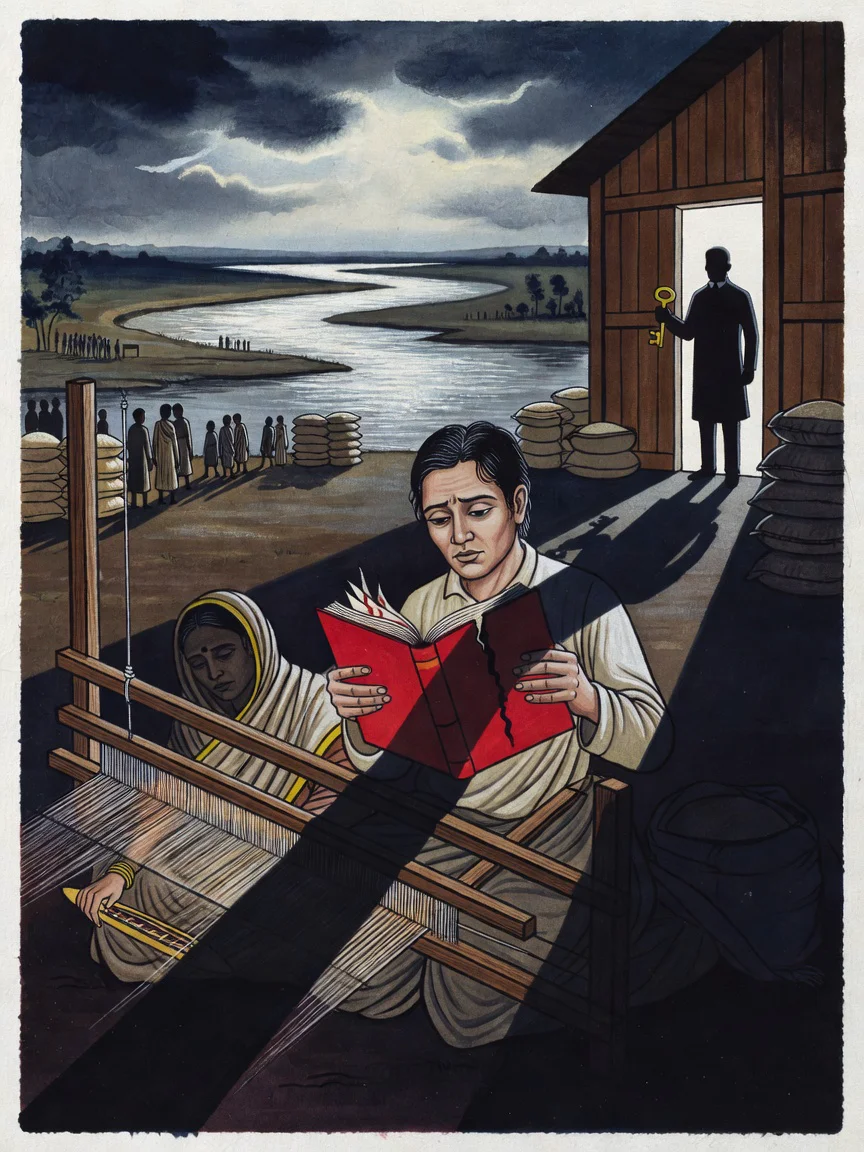

The Price of Rice
The famine has an account. Her name is at the bottom.
- ~190 min
- 33127 words
- 74 scenes
- 11 branch points
- 7 endings
- Murshidabad and Kasimbazar, Bengal, February–September 1770
101 recorded plays (one per visitor per day)
Cover art · listing metadata: listing.json · counts: authored
About
Kasimbazar, Bengal, 1770. The rice measure shrinks every week and the Company's cloth ledgers remain exact to the pice. Jamuna Das is a gomastah, one of the native agents who carries advances into weaving villages and returns with silk, cotton, or somebody's loom. Forty-three households owe money under her name. Seventeen principals are already dead. Halima Bibi, a widowed master weaver with one incomparable loom, owes eighteen rupees and has nothing left to surrender except the instrument of her living. Jamuna has been ordered to mark it for seizure. The order comes through Ramkanta Dey, the banian who taught Jamuna Persian accounts, guaranteed her employment, and made a commercial woman legible to men who would not otherwise admit she existed. He has pledged her entire book of advances against a private grain corner: four hundred and eighty maunds locked in a brick warehouse while people die at its doors. When the September audit comes, failed cloth will become Jamuna's debt and the rice will become Ramkanta's fortune. The proof is divided among incompatible witnesses—a warehouse tally hidden in Halima's loom beam, a Persian duplicate controlled by a hostile auditor, and the private memorandum of Alexander Pyne, a junior Company servant whose kindness is genuine, whose complicity is profitable, and whose passage home is already booked. The Price of Rice is an adult historical drama about monopoly wearing the clothes of procedure. Jamuna can steal grain, falsify death, enforce contracts, expose the men above her, or learn to profit as they do; every mercy transfers its cost to another body. Her desire for Halima asks her to destroy a law she once survived by enforcing. Her love for Pyne asks whether a decent man may keep money made indecently. Around them: smallpox graves, a cholera-like purging sickness, opium dependence, grain boats waiting behind a flood island, master cloth cut into shrouds, and an audit that turns mass death into balanced columns. Eleven consequential choices lead to seven materially different endings. None asks whether Jamuna can remain innocent. The question is whose hunger her innocence would buy.
Content notice12 topics · tap to review
- famine and starvation
- mass death and corpses
- colonial and caste oppression
- debt bondage and seizure of livelihoods
- cholera-like epidemic illness
- smallpox referenced
- graphic violence where earned
- opium dependence
- fraud, hoarding, and institutional corruption
- sexual content implied, cuts away
- bereavement
- no slurs written out
Cast
-
 Jamuna Das
protagonist; Company gomastah responsible for forty-three weaving households
Jamuna Das
protagonist; Company gomastah responsible for forty-three weaving households
-
 Halima Bibi
widowed master weaver; Jamuna's debtor and beloved
Halima Bibi
widowed master weaver; Jamuna's debtor and beloved
-
 Alexander Pyne
junior Company servant; decent, complicit and preparing to go home rich
Alexander Pyne
junior Company servant; decent, complicit and preparing to go home rich
-
 Ramkanta Dey
banian, Jamuna's mentor and guarantor; architect of the grain corner
Ramkanta Dey
banian, Jamuna's mentor and guarantor; architect of the grain corner
-
 Munshi Karim Ali
Persian auditor; guardian of records that can preserve or erase the dead
Munshi Karim Ali
Persian auditor; guardian of records that can preserve or erase the dead
-
 Gauri Sen
widowed grain-boat factor; keeper of the flood landing
Gauri Sen
widowed grain-boat factor; keeper of the flood landing
-
 Nabin Chandra Sen
vaidya running the silk-godown sick ward
Nabin Chandra Sen
vaidya running the silk-godown sick ward