 Netwrck
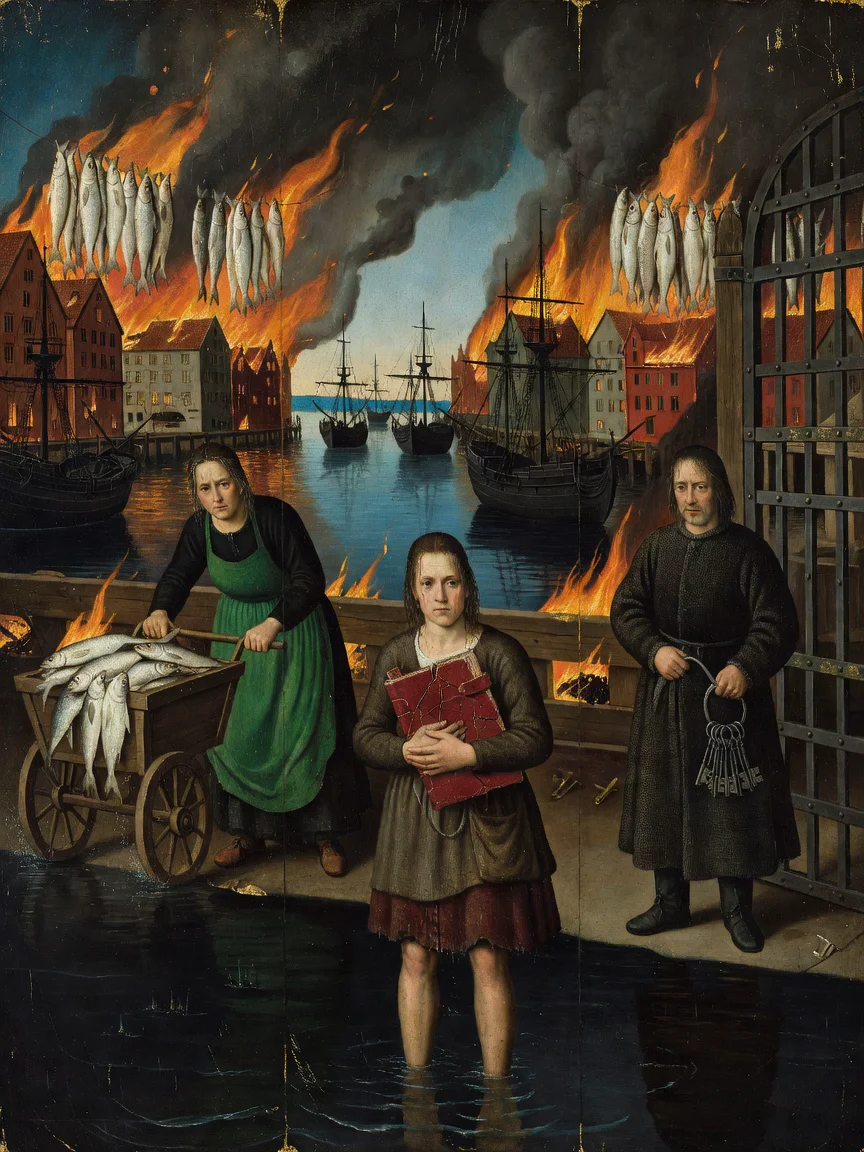

The German Wharf
The fish belongs to a dead man. The hunger belongs to everyone.
- ~190 min
- 29053 words
- 75 scenes
- 12 branch points
- 7 endings
- Bergen, Norway, summer to Michaelmas 1427
116 recorded plays (one per visitor per day)
Cover art · listing metadata: listing.json · counts: authored
About
Bergen, 1427. Stockfish hangs in the German warehouses like split white timber, grain ships fail to arrive, and every loaf has acquired a creditor. For nineteen months Alheid Kroning has run her dead husband's house under his seal, an illegal widow making honest entries beneath a false name. One last summer cargo could buy a city licence, a waterfront house, and a life outside the Kontor's celibate discipline. Instead, Hinrich — the apprentice she taught, fed, and raised into partnership — has signed all sixty-four våg of her stock to the aldermen. His price is the hearth-right Alheid thought they were earning together. His final service will be to testify that her books are forged. The people who can save her are the people her trade has helped injure. Sigrid Ask, a fish-buyer from Nordnes, has hidden Alheid's goods while German famine prices empty her family's bread chest. Cord Wullen, the Kontor's schuetenmeister, carries the keys to every barred gate and enforces rules he has come to hate only after those rules made him powerful. Each offers Alheid a different kind of treason and a different adult love. Sigrid asks her to spend German proof on Norwegian lives. Cord asks her to make his secret disgust visible, knowing the institution will punish the visible traitor and preserve the obedient hypocrite. Desire remains in the wet wool, the shared knife, and what is said the morning after the door closes. Then Victual-brother ships enter Vågen twice. The Kontor's men protect their grain and do not fight while the town that enriches them burns. Ledgers must be carried past bodies; wet stockfish becomes food, evidence becomes kindling, and a brutal apprentice initiation echoes through the men choosing which gate to open. The first sack destroys the old bargains. The second lets creditors rebuild them in fresh timber. Across four acts and seven materially different endings, Alheid can expose the monopoly, inherit part of it, feed the district it starved, or leave its books to someone more dangerous. She cannot preserve her fortune, her name, both loves, and the usable truth. The town will be rebuilt. The question is whose debt is mortised into the beams.
Content notice10 topics · tap to review
- famine and food deprivation
- widowhood and grief
- institutional misogyny and xenophobia
- coercive debt and threatened homelessness
- graphic fire injuries and violent death
- workplace assault and brutal apprentice initiation
- alcohol misuse
- sexual content implied, cuts away
- betrayal by a dependent and business partner
- no slurs written out; bigotry shown through behaviour and consequence
Cast
-
 Alheid Kroning
protagonist; a widow trading illegally under her dead husband's seal
Alheid Kroning
protagonist; a widow trading illegally under her dead husband's seal
-
 Sigrid Ask
Norwegian fish-buyer; Alheid's smuggler, creditor, and lover
Sigrid Ask
Norwegian fish-buyer; Alheid's smuggler, creditor, and lover
-
 Cord Wullen
Kontor schuetenmeister; keeper of the gates and reluctant enforcer
Cord Wullen
Kontor schuetenmeister; keeper of the gates and reluctant enforcer
-
 Hinrich Voss
former apprentice turned partner; betrayer and claimant to the Kroning stock
Hinrich Voss
former apprentice turned partner; betrayer and claimant to the Kroning stock
-
 Gerke Brandt
senior Kontor alderman; defender of the grain reserve and monopoly
Gerke Brandt
senior Kontor alderman; defender of the grain reserve and monopoly
-
 Ragnhild Torgilsdatter
Bergen council clerk; custodian of market records and public blame
Ragnhild Torgilsdatter
Bergen council clerk; custodian of market records and public blame
-
 Jost Breden
first-year apprentice; survivor and unwilling proof of Kontor discipline
Jost Breden
first-year apprentice; survivor and unwilling proof of Kontor discipline