Netwrck
Speculative fiction.
Counter 19
The Department of Missing Tuesdays occupied three basement floors beneath the vehicle-registration office. Nobody entered on purpose. The lift button had no label, and the stairwell door appeared only when a citizen had lost more than six consecutive hours.
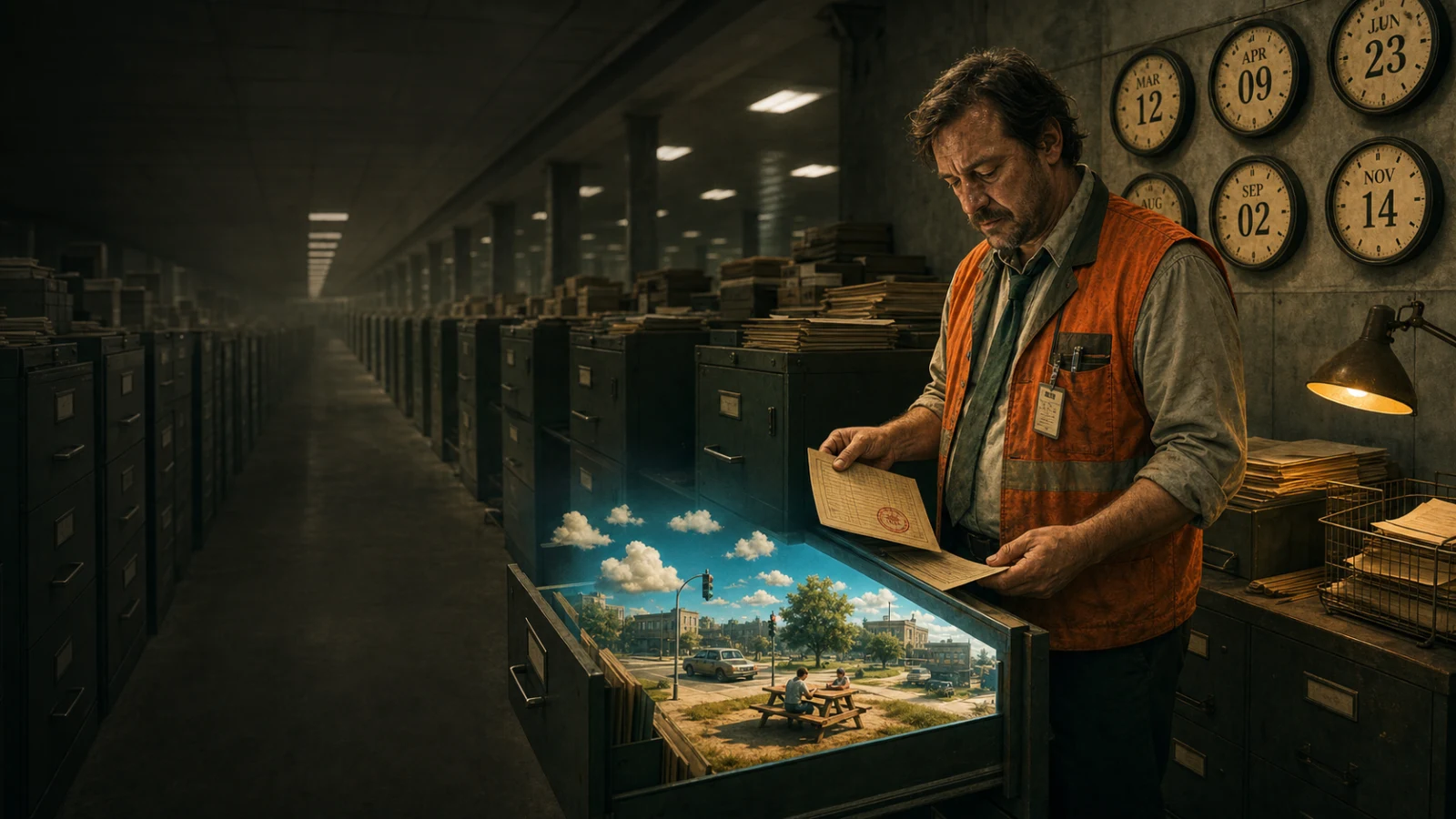
Oona Vale worked Counter 19, Repossessed Weekdays, Municipal Accounts. She wore an orange safety vest because the union had proved that lost time was an active worksite. At eight every morning she unlocked the steel drawers, counted the afternoons, and listened for anyone knocking from inside.
Most repossessions were small. Seven minutes removed from a late bus. An hour seized from a teenager who had spent it pretending to revise. The city bundled these fragments and sold them to hospitals, airports and restaurants that needed a little more day at the end of every shift.
Whole weekdays were rarer.
At 9:12, a woman placed a library card on Oona's counter.
“Tuesday is gone,” she said.
“Last Tuesday or Tuesdays generally?”
“All of them. My calendar goes Monday, Wednesday. My daughter was born on a Tuesday and now the hospital says she was never discharged.”
Oona opened Form T-0, Suspected Loss of Recurring Day. “Do you owe the city money?”
“Everyone owes the city money.”
“Specifically.”
The woman unfolded a water bill. Red letters covered the meter number: PAYMENT DEFERRED INTO FUTURE LABOR.
Oona had seen the stamp once before, on her brother Dani's account.
The Drawer That Rained Upward
Drawer 8,441 contained a Tuesday measuring twenty-three hours and fifty-eight minutes. Two minutes had leaked during transport. When Oona pulled the handle, warm rain rose from the carpet into a blue sky fitted neatly between hanging folders.
Inside the drawer, cars waited at a traffic light. A dog shook itself dry in reverse. People ate lunch at picnic tables and stared past Oona as if an open wall in the universe was a common municipal inconvenience.
Dani sat on the nearest table wearing the denim jacket he had vanished in eleven years ago.
He was twenty-six. Oona was now forty.
“You took your time,” he said.
Oona gripped the drawer until the metal edge hurt. “You died.”
“Accounting word.”
“Mum buried your shoes.”
“They pinched.”
Behind him, Tuesday repeated. The light turned green, cars moved, rain fell down, rain climbed back into the clouds, and the light turned red again.
Dani explained that the city had repossessed the day of his fatal accident before the accident finished. The ambulance entered at 4:06 p.m. The drawer closed at 4:07. With the day held as collateral, nothing inside it could legally conclude.
“I have been nearly dead for eleven years,” he said. “It gets repetitive after the first eight.”
Oona checked the drawer tag. The Tuesday had been collateral against thirty-one thousand unpaid water accounts. Releasing it would restore Dani, the library woman's daughter and every Tuesday erased from the affected districts. It would also remove 264,000 hours from the Municipal Time Reserve.
The reserve powered emergency rooms, overnight freight and the mayor's promise that downtown bars could remain open forever.
“Can you step out?” Oona asked.
Dani tried. At the drawer's edge his hand became a stack of numbered receipts.
“Apparently I am infrastructure,” he said.
The Audit
Oona requested the repossession ledger. Her supervisor refused. She requested it again under the Bereaved Sibling Access Rule. Her supervisor said siblings were not bereaved while the deceased remained useful.
At lunch, Oona followed a pipe marked SURPLUS DURATION to Sublevel Three.
The city kept its time reserve in glass tanks. Dawn foamed at the top. Childhood summers settled in a gold layer near the bottom. A technician skimmed five-minute intervals from the surface and sealed them in silver canisters labeled PRODUCTIVITY.
“Where do recurring Tuesdays go?” Oona asked.
The technician pointed to a blue main running toward the wealthy northern ridge.
“Extended weekends,” he said. “Premium district.”
Oona opened the audit terminal. The screen showed the city not as streets but as a calendar. In the north, Saturdays spread across three days. Along the river and the freight yards, weeks had narrowed to Monday, Wednesday and the anxious portion of Sunday evening.
The missing days were not paying debt. They were paying comfort.
Oona copied the ledger onto a roll of cafeteria receipts. Time records could not be emailed because transmission aged them. By the time a leak reached a journalist, it was usually old news.
Her supervisor found her at the printer.
“You cannot return a collateral day,” he said.
“Why?”
“The city scheduled things in it.”
“People scheduled lives in it.”
“Lives are provisional. Schedules are binding.”
He offered Oona a promotion to Senior Wednesday. The role came with dental care and one protected birthday every four years.
Oona asked for ten minutes to consider.
He approved eight.
Tuesday, Released
At 4:06 p.m., Oona wheeled Drawer 8,441 into the public lobby.
Citizens waiting for licence renewals looked up as rain rose from their coats. The Tuesday inside the drawer widened until its sky touched both walls. Traffic noises filled the basement. Somewhere beyond the impossible light, an ambulance siren remained one note away from completion.
Oona fed the cafeteria receipts into the queue-number machine. Instead of tickets, it printed the names of every person whose time had been taken. The names curled across the floor and climbed the stairs.
Her supervisor reached for the emergency lock.
Dani reached from inside.
Oona took his receipt-paper hand and pulled.
The drawer came with him.
Metal cabinets opened across three floors. Seven-minute delays, abandoned afternoons and entire wet seasons rushed into the lobby. People aged, became younger, remembered appointments, forgot marriages, finished cups of coffee set down years earlier. Every clock in the building screamed a different hour.
Dani fell onto the tiles, twenty-six and forty and briefly nine years old. Then time selected a version it could defend. He became thirty-seven, with grey at his temples and a healed ambulance scar across his chest.
“Did it work?” he asked.
Above them, the city received Tuesday all at once.
Schools reopened in the middle of lessons. Bakers found fresh loaves cooling on racks they did not remember filling. The premium district lost its third Saturday and discovered Monday waiting underneath. At the hospital, a girl who had been newborn for six years finally cried.
The mayor declared a temporal emergency and asked residents to remain in the present until further notice.
Oona and Dani left through the vehicle-registration office. Outside, warm rain lifted from the pavement into a clean blue gap between buildings.
“What happens now?” Dani asked.
Oona looked at the receipt roll in her hand. Thousands of names remained.
“Tomorrow,” she said.
For the first time in eleven years, tomorrow meant Wednesday.