Netwrck
Fiction.
The Shop Window
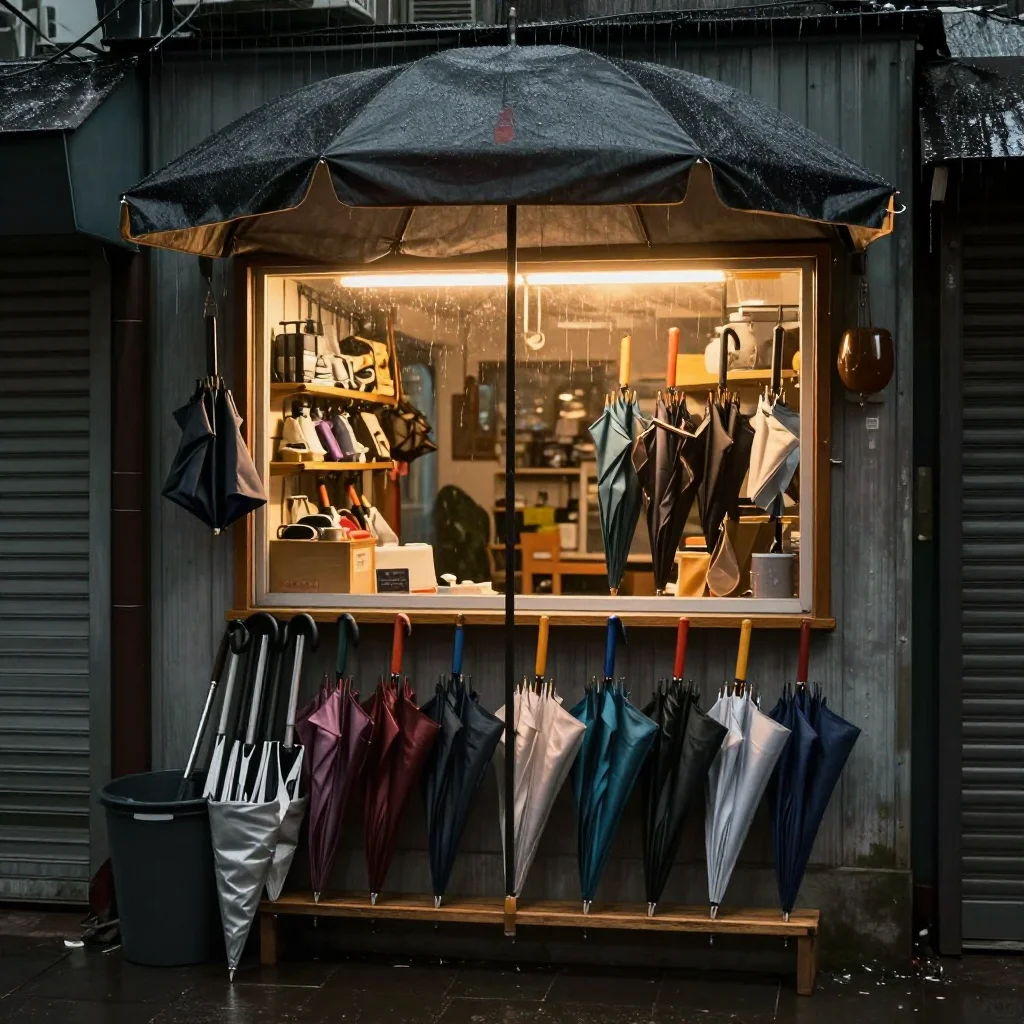
The signs had been up so long they had come to look permanent. AUTHORISED UMBRELLA REPAIRS in gold paint, a little flaked at the edges, and beneath it, in small letters Mona had added over the winter because the rent had gone up twice and somebody had to say it: Nothing is beyond mending. Bring us what you have broken.
The city rained for eight months a year and then rained politely for the other four, which is why Mona's shop had survived where the bakeries had not. People threw away an umbrella at the first broken rib and bought another at the pharmacy, and then, every now and again, a certain kind of person brought one in and said, "It is a good one. See if you can do anything."
Mona could do anything. She had learned from a man named Pietro in a shop that no longer existed, who had taught her that an umbrella was a small roof and that a small roof was a kind of promise for one person. He had said the most important tool was not the needle or the steel but the patience to look at a thing for a long time before touching it.
Pietro had died in the spring, which is why the shop was closing at the end of the month, which is why the woman with the umbrella was finally standing at the counter.
The Good Umbrella
The umbrella was black, forty years old if it was a day, with a solid brass ferrule and a shaft of real wood polished to the colour of a table in a house you had been happy in once. It folded with the particular reluctance of a thing that had not been opened in a long time.
The woman was old too, and neat, and she held the umbrella the way other people held a handbag.
"It belonged to my son," she said. "He died last year. I want it fixed."
Mona took it. "The frame is fine. It is only the runner and one rib and the handle fitting. I can do that."
"He carried it every day. He was on his way to work the morning. It did not help."
The woman said this without drama, the way people said things they had said many times, and whose edges had been worn down to a plain smooth fact. Mona turned the umbrella in her hands and saw that the handle had a maker's mark she had not seen in twenty years, the little crossed hoops of a firm that had gone under before she was born.
"I know this one," she said. "Pietro would want me to see it. He would want me to tell you that this is a good umbrella."
"How do you know?"
"Because the rib is still straight, forty years in. Fifty. It has been rained on, not treated badly."
The woman nodded slowly. "He was careful with things. He said it was the one thing he knew how to be."
Mending
Mona worked in the back room where the light was good and the bench was scarred with old work. She stripped the umbrella down to its bones and laid the parts out, and the oilcloth came away grey from use. She cleaned the rib with a soft cloth and straightened the bent runner with a pair of pliers she had inherited from Pietro. She sawed a new hardwood end for the handle, not to replace what was there but to give it something to hold on to, and fitted it, and sanded it down until the grain met the old wood like a seam it had always been.
People think a repair is a thing you do to an object. It is not. It is a thing you do to time. You go back to the place where it broke and you knit something new into the break, and the whole thing is stronger for the seam if the person who does it cares enough to make the seam invisible.
Mona had fixed umbrellas for thirty years. She had fixed them for a man who stood in the rain to wait for a bus that never came because he was dead; she had fixed one for a bride whose sister had died the morning of the wedding; she had fixed a child's umbrella with cartoon dogs on it, one of those cheap ones, and sent it back with no charge. The mothers cried. The children learned to carry it because it had been fixed for them.
The most important tool is not the needle or the steel. It is the patience to look at a thing for a long time before touching it. Pietro used to say that, and he was right.
What the Rain Knows
She called the woman on Thursday to say it was ready. The woman came in the late afternoon, when the light in the shop had gone amber and the gold on the sign was catching the last of the sun.
Mona held it up. The umbrella opened in one motion, a clean and whole black arc, and for a moment the two of them stood under it in the middle of a dry shop on a dry day, and neither of them said anything.
"It is like new," the woman said.
"It is not like new," Mona said. "New things are thin. This has been around. It knows what rain is for."
The woman paid, folded the umbrella carefully, and put it under her arm. She stood a moment at the door.
"He carried it in the rain," she said. "He said it made him feel he was doing something about it."
"He was," Mona said.
The woman went out and the weather, which had been holding off all week, began to rain. Mona watched her open the umbrella under the streetlight and continue down the walk, black and whole, a small roof for one person moving through the city. She watched it disappear into the grey and stood there with her hand on the doorpost in the old shop that was closing at the end of the month.
She looked down at the bench, at the scarred wood and the pliers and the box of brass ferrules Pietro had left her, and she thought about what she would carry out of the shop with her when it closed. A bench. A box of tools. A habit of looking at a thing for a long time before touching it. She thought that was more than she had had on the day she walked in, young and angry and needing a job, and she turned off the light and locked the door and went out into the rain without an umbrella, which is how you know the next one is coming.